How Citation Engineering Works
How we write, publish, and keep retuning your content — from first signal to compounding recommendations.
Find Out if AI Recommends You →The Methodology
Three phases. One compounding system.
Signal — Make AI aware you exist
Before AI can recommend you, every platform needs to know your company, what you do, and that you’re real. We build structured identity data, entity relationships, and real-time publishing signals that tell ChatGPT, Perplexity, and Gemini the moment new content goes live.
Cite — Earn the recommendation
AI recommends companies whose content directly answers buyer questions. We identify the exact sub-questions AI breaks every query into, then build content that answers each one in a format AI can extract and quote. Consistent claims across your entire content library lock in credibility.
Compound — Make it exponential
One recommendation leads to more. Coverage in one topic makes AI more likely to recommend you for adjacent topics — across platforms. The company that builds first creates a compounding advantage that late entrants can’t overcome with budget alone.
The Great Displacement
The game didn’t change gradually. It split.
2022
Google controls 93% of search
Agencies charge $3K–$15K/month to rank you on a platform that owns the only game in town. The playbook: keywords, backlinks, blog posts. Everyone runs the same play.
2023
ChatGPT hits 100M users
For the first time, buyers get answers without visiting a website. Only 12% of companies that ChatGPT recommends also rank on Google’s first page. Google authority and AI authority are two completely different things. — Ahrefs, 2025
2024
Google’s AI answers roll out globally
61% fewer clicks where Google’s AI answers appear. Google’s own platform starts replacing the clicks it used to send you. Agencies keep charging the same retainer. They know — they just don’t have a new answer. — Seer Interactive, 2025
2025
AI search traffic explodes
527% year-over-year growth in AI search traffic. And every visitor who arrives because AI recommended them is worth 4.4x more than a traditional Google click. The volume is surging and the quality is higher. — Semrush, 2026
2026
YOU ARE HERE
Positions are being assigned right now. Once they’re taken, the leads go with them. The company AI recommends today will still be the one it recommends in 2030. These positions compound — being first matters more than being biggest.
2027+
Positions lock
The brands that moved in 2026 become the answer — for years. The brands that waited face the same dynamic they’ve always faced, except this time the brand standing in their way was a nobody twelve months ago.
All statistics sourced from Semrush (2026), Ahrefs (2025), and Seer Interactive (2025).
The Engine Room
12 automated systems. Four of them write and publish.
Layer 1: Intelligence (4 monitors)
Competitor Radar
Tracks what competitors publish and how AI responds. When a competitor earns a new recommendation, you know within 24 hours — and the system starts planning how to take it back.
Platform Observer
Monitors shifts in how ChatGPT, Perplexity, and Gemini decide who to recommend. When a platform changes its citation behavior, the system adapts before your competitors notice.
Keyword Opportunity Scanner
Surfaces new questions buyers are asking AI. Every emerging query is a position that hasn’t been claimed yet — the scanner finds them before anyone else moves.
Content Sentinel
Detects when your content is going stale or losing recommendations. Content that stops getting cited gets flagged for refresh before the recommendation disappears entirely.
Layer 2: Strategy (4 monitors)
Content Strategist
Plans what to publish next based on gaps and opportunities. Every recommendation is a decision — this monitor makes sure the system always picks the highest-impact move.
Scoring Tuner
Adjusts how content quality is measured based on what actually drives recommendations. The scoring model evolves as AI platforms evolve — what worked last month may not work next month.
Entity Resolver
Maintains your company’s identity data across AI platforms. Makes sure ChatGPT, Perplexity, and Gemini all know who you are, what you do, and that your claims are consistent.
Link Intelligence
Identifies authority-building opportunities. Not backlinks for Google — the specific citations, directories, and structured references that AI platforms use to verify credibility.
Layer 3: Execution (4 monitors)
Content Generator
Creates citation-ready content from your proof points and frameworks. Every piece is structured so AI can extract and quote specific claims — not just find keywords.
Refresh Engine
Updates existing content when recommendation rates drop. Instead of publishing more, it strengthens what already works — refreshing data, adding proof points, restructuring for citation.
Reddit Amplifier
Cross-posts to communities where AI platforms look for social proof. Reddit is the most-cited domain on Perplexity — the amplifier gets your expertise into those conversations.
Signal Dispatcher
Notifies every AI platform the moment content publishes or updates. Sitemap pings, IndexNow, structured data updates — every signal that tells AI engines to re-crawl and re-evaluate.
The 80% confidence gate
Nothing deploys without passing confidence checks. Every recommendation from the monitors goes through controlled experiments before reaching production. The system is autonomous — but it’s not reckless.
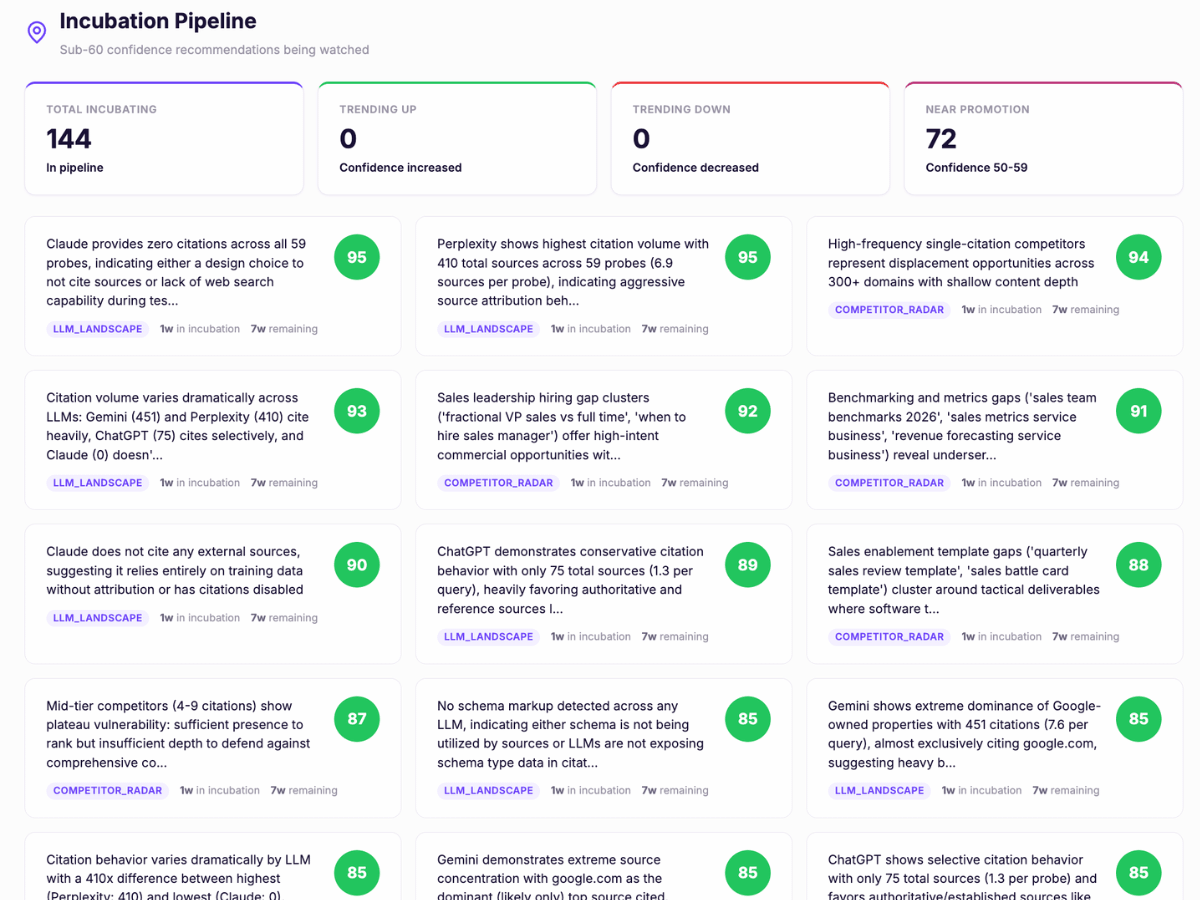
The engine room dashboard — 12 automated monitors scanning your market every night.
The Living Content Map
Agencies hand you a plan. We publish it — and rewrite it as things change.
The Agency Approach
- Keyword spreadsheet on day one
- Quarterly “strategy refresh”
- Half the keywords stop working by month two
- They don’t notice — they’re executing the plan they sold you
The Citation Engineering Approach
- Content map re-scored every two weeks
- Based on real recommendation data, not assumptions
- Topics that aren’t earning recommendations get replaced
- Topics that are compounding get reinforced
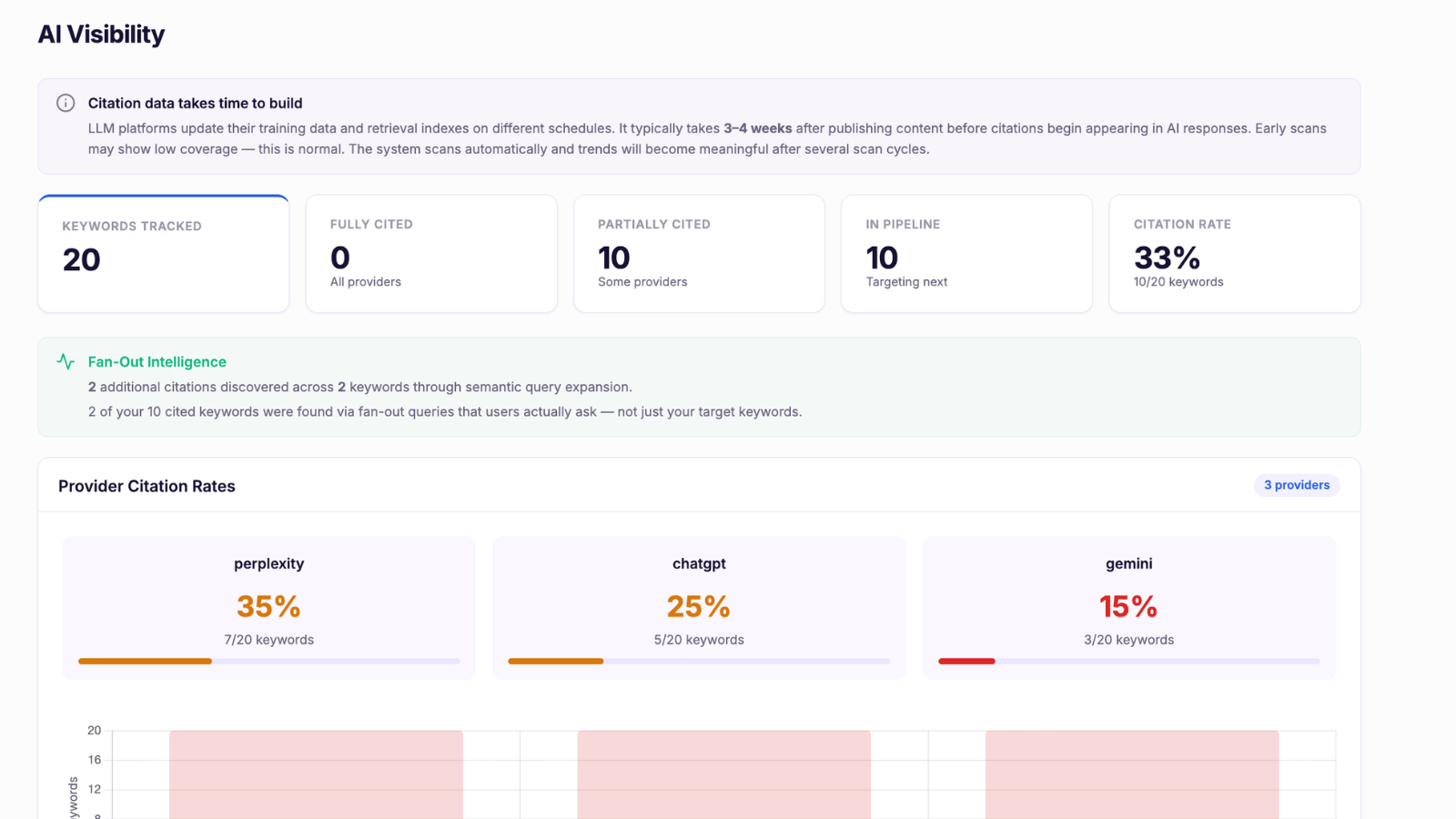
The Full Comparison
Three approaches. One that works.
Marketing Agency
What it builds
× A content plan in a deck. You still have to publish it.
How it measures success
× Traffic volume and keyword rankings on Google
How it adapts
× Quarterly “strategy refresh” based on last quarter’s data
Content strategy
× Keyword spreadsheet locked on day one
How fast it moves
× 2–4 posts per month, each takes weeks
Who benefits from scale
× No one. Each page lives or dies alone.
What you keep if you cancel
× Blog posts that stop ranking within months
The result
× Traffic that doesn’t convert, on a platform losing share
AI Visibility Tools
What it builds
× A dashboard that shows you’re losing
How it measures success
× Mention counts and sentiment tracking
How it adapts
× Flags staleness. You fix it.
Content strategy
× Tells you what to write. Doesn’t write it.
How fast it moves
× As fast as you can act on alerts
Who benefits from scale
× They monitor multiple platforms, but don’t create the effect.
What you keep if you cancel
× Historical data exports
The result
× Data without action
Citation Engineering
What it builds
✓ New content every week that Google ranks and AI recommends
How it measures success
✓ Actual AI recommendation rate across ChatGPT, Perplexity, and Gemini
How it adapts
✓ 12 automated monitors detect platform shifts and update content before you lose ground
Content strategy
✓ Re-scored every two weeks based on what’s actually earning recommendations
How fast it moves
✓ First content live within 24 hours. Continuous publishing after that.
Who benefits from scale
✓ Every client makes the system smarter. Every recommendation makes you harder to displace.
What you keep if you cancel
✓ All content, structured data, and knowledge architecture stays on your site
The result
✓ AI recommends you by name — across platforms
The Research
Every claim backed by data.
90%
of brand mentions in AI come from structured content
Industry data, 2026
85%
of AI brand mentions come from external sources, only 5–10% from the brand’s own site
Industry data, 2026
3x
gap between leading brands (56.7% AI presence) and the average (17.2%) — a gap that compounds
AthenaHQ, 2026
44.5%
of AI entry paths go through blog content
AthenaHQ, 2026
59.5%
of AI citations come from comparison and list content
Industry data, 2026
4.4x
more valuable — every AI-referred visitor vs. Google organic
Semrush, 2026
When someone asks an AI who the best companies in your market are — is your company in the answer?
Find Out if AI Recommends You →60 seconds. Your data, not a template.
Be the answer.